

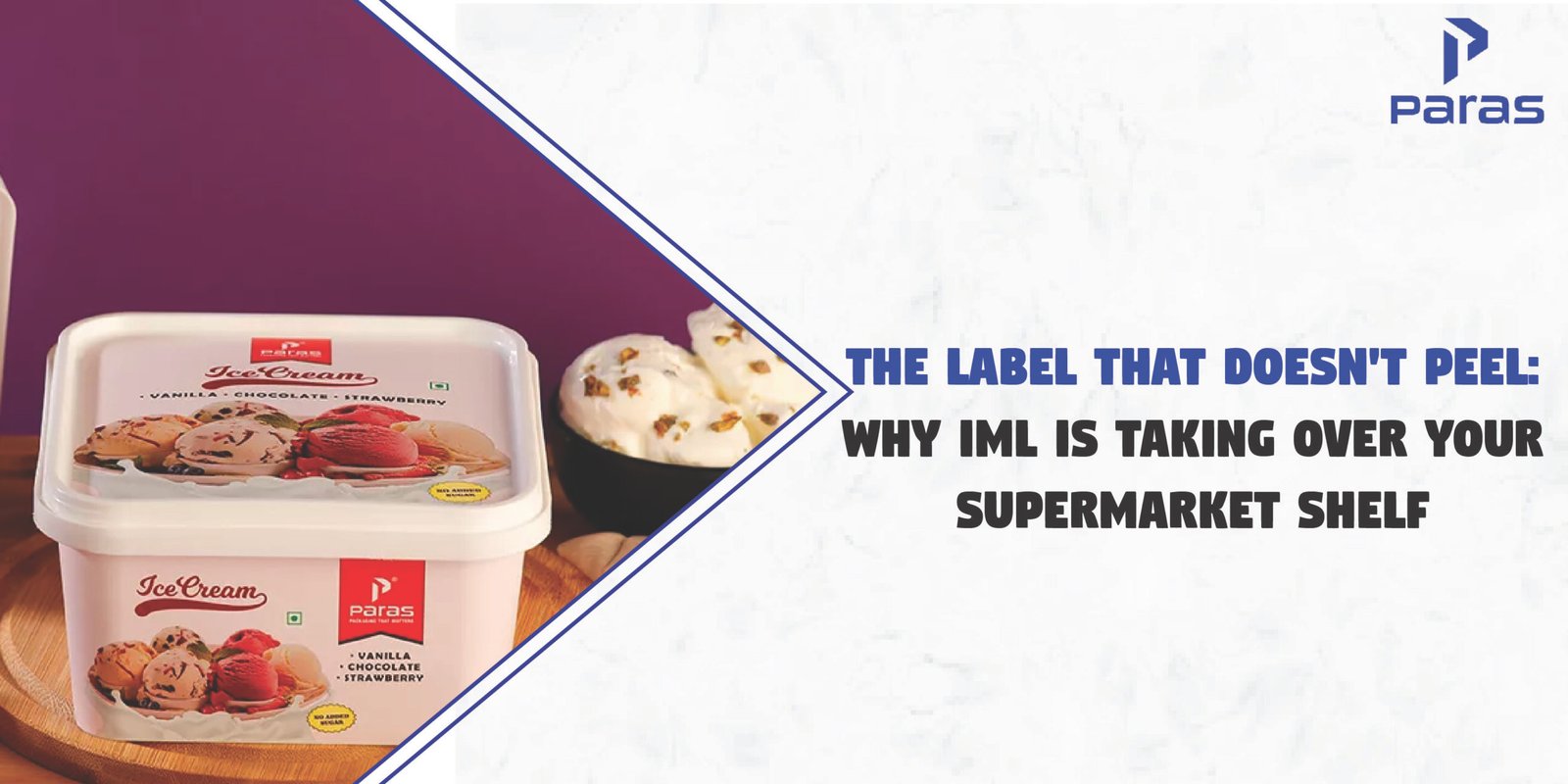
We have all seen it happen in the freezer aisle. You pick up a tub of ice cream or frozen yogurt, and the paper sticker is already failing. The condensation has soaked into the glue, the corners are curling up, and the branding looks tired before you have even bought it.
If your packaging looks cheap, customers will automatically assume the product inside is cheap as well. The regular pressure-sensitive labels, i.e., stickers, hate moisture, temperature changes, and friction. In a supply chain full of all three, relying on a sticker is a risk. IML (In-Mould Labeling) was invented specifically to solve this failure.
What is IML Exactly? (Think of it as a Tattoo)
To understand IML, you have to stop thinking about “sticking” a label onto a finished tub. That is the old way. In IML, we place the pre-printed label inside the empty steel mould before the liquid plastic is injected.
When the hot plastic shoots into the mould, it melts slightly into the label. As it cools, they fuse together. The result is that the label and the container become one single piece of Polypropylene. It isn’t a sticker on the skin but a tattoo. You cannot peel it off without destroying the container itself.
Why Are IML Containers Better Than Stickers?
- Zero Peeling or Bubbling: Since there is no adhesive glue used, the label cannot fail. It won’t bubble in the heat, and it won’t peel off in the freezer. It stays pristine from the factory to the customer’s fridge.
- High-Definition Branding: Stickers are limited by where a machine can place them. IML wraps around the entire curve of the container, top to bottom. You get 360-degree high-definition graphics that make the product pop on the shelf.
- One-Step Manufacturing: We don’t need a separate machine to apply labels after the tub is made. The container comes out of the mould fully decorated. This speeds up production and reduces the chance of misalignment errors.
- Easier Recycling: Stickers are usually made of paper or a different plastic, which contaminates the recycling stream. IML labels are made of the same plastic (PP) as the tub. The whole thing can be recycled together without separating anything.
Is it Safe for Direct Food Contact?
Hygiene is the main reason the food industry loves IML. Traditional labels use adhesives (glues) to stick to the plastic. Over time, or with heat, those adhesives can migrate or degrade. They also create a tiny gap between the label and the tub where bacteria and fungi can grow if the moisture gets in.
IML eliminates the glue part entirely. The fusion is chemical-free and airtight. It creates a sterile and easy-to-clean surface that is perfect for dairy, ice cream and ready-to-eat meals. It is safer because it is simpler.
Will It Survive the Supply Chain?
Shipping is violent. Boxes get thrown, shaken in the trucks, and stacked on top of each other. Painted containers scratch easily, and stickers tear when they rub against cardboard.
IML containers are naturally scratch-resistant. Because the ink is usually protected by a thin layer of label’s coating, it can take a beating. Your product arrives at the retail store looking exactly as sharp as it did when it left your warehouse.
Stop Losing Customers to Peeling Labels
You spend months perfecting the product inside the tub. Don’t let a cheap sticker ruin the first impression. If your label is wrinkled or peeling, customers automatically assume the quality inside is poor, too. IML isn’t just a decoration; it is insurance that your brand looks professional every single time a customer picks it up.
It’s time for you to ditch those stickers, contact us at iml@paraspack.in, and we’ll upgrade your shelf presence.
FREQUENTLY ASKED QUESTIONS
Can I Use IML for Frozen Products like Ice Cream?
Yes, it is the standard for ice cream. IML is waterproof and immune to cold. Unlike paper stickers that get soggy from condensation when you take the tub out of the freezer, IMl stays perfectly flat and readable.
Is IML Expensive Compared to Normal Labeling?
The initial setup (creating the mould and the label design) is higher than just printing stickers. However, for large runs, the unit cost is lower because you skip the entire labeling stage of production. It saves money on labor and time.
Can the Customer Put these Containers in the Microwave?
Yes, since the label and the tub both are made of Polypropylene (PP), they are microwave-safe. The label won’t spark or melt like some metallic foils or cheap glue would.
Can I Change the Label Design Easily?
Yes, you don’t need to change the shape of the container or the mould. You just load a different stack of labels into the robot. You can run “Chocolate,” “Vanilla,” and “Strawberry” in the same shift just by swapping the labels.
Does the Label Scratch off If I Wash the Container?
No, the container is dishwasher safe. A lot of customers reuse the UML tubs like the ice cream containers for storing leftovers, specifically because the label doesn’t degrade or peel off in hot water.